Persona Decision Coach
Designing “Not-Knowing” AI Personas to Improve Human Decision-Making
Role
HCI Researcher
Client
Decision Education Foundation
Responsibilities
User Research & Evaluation, Interaction Design, Decision Quality Framework Integration, Pilot Study Design & Analysis
Tools
LLM-based evaluation, State-based persona engine, Session analytics
Project Brief
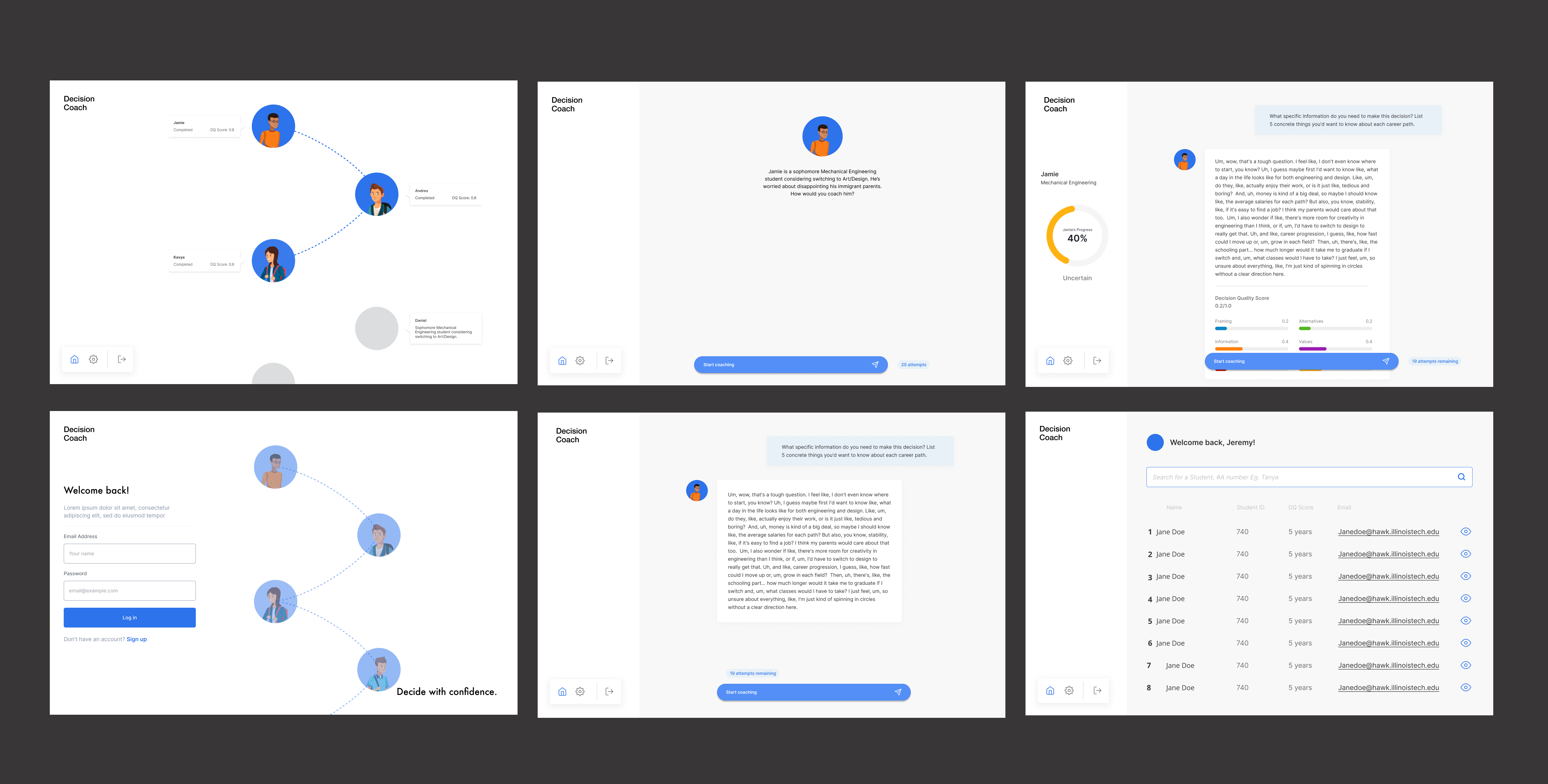
Persona Decision Coach is an AI-powered conversational platform designed to study and improve how people make complex decisions. Instead of receiving advice from an expert AI, users coach a realistic AI persona who is uncertain about a life or career decision.
By guiding the persona—asking questions, clarifying values, and exploring alternatives—users actively practice structured decision reasoning. Every interaction is evaluated using the Decision Quality (DQ) framework, allowing the system to measure how people frame problems, consider alternatives, reason with information, and move toward commitment.
The platform functions both as a learning environment and an HCI research instrument, enabling controlled studies on how AI interaction design shapes human agency, trust, and decision behavior.
“Not-Knowing” AI
Most AI systems present themselves as all-knowing experts that provide answers directly. This design often positions the user as a passive recipient.
Persona Decision Coach explores an alternative interaction paradigm: AI personas are intentionally “not-knowing.” They are confused, conflicted, or overwhelmed and require the user’s help to think through a decision.
User becomes the coach
Active role in structuring the decision process
AI becomes the learner
Persona receives guidance and evolves through the conversation
This approach encourages users to externalize reasoning, articulate trade-offs, and actively structure the decision process. Early studies suggest that not-knowing AI personas increase engagement and strengthen users’ sense of decision ownership compared to expert-style AI systems.
Decision Quality Framework
All user messages are evaluated against the six elements of Decision Quality, a professional decision-analysis framework used in industry. The system scores coaching interactions across:
Each conversation turn is scored automatically, enabling fine-grained measurement of decision reasoning during interaction.
Interaction Design
The platform structures decision coaching as a staged interaction.
-
1
Persona Selection – Users choose from research-driven personas representing common decision dilemmas (e.g., career transitions, relocation, entrepreneurship).
-
2
Coaching Conversation – The persona describes their situation and uncertainty. Users respond as coaches—asking questions, reframing problems, and exploring alternatives.
-
3
Real-Time Decision Quality Scoring – Each user message is evaluated across the six DQ dimensions.
-
4
Persona Evolution – As coaching improves, the persona’s internal state evolves (e.g., overwhelmed → exploring → experimenting → visioning).
-
5
Session Analytics – After the interaction, users receive feedback summarizing which decision dimensions were addressed, where reasoning was strong or weak, and how far the persona progressed. This transforms the system into a scaffolded learning loop for decision reasoning.
Results from initial controlled study
To test the platform, we ran an initial controlled study with 30 users with no prior Decision Quality training. Data collected: 900+ conversational utterances, 10-turn coaching sessions, and real-time DQ scoring per message.
60%
Average DQ score increase within a single session
+100%
Largest gain: Commitment to Action
+88%
Reliable Information dimension
These findings suggest that learning-by-teaching through AI personas can rapidly improve decision reasoning skills.
Research Questions
The platform enables experimental studies on AI–human interaction in decision contexts.
- Decision Skill Development: Does coaching an AI persona improve users’ ability to structure and reason through decisions?
- AI Interaction Design: How do not-knowing vs. expert AI personas influence decision ownership, engagement, trust, and willingness to express uncertainty?
- Behavioral Transfer: Do users apply structured decision reasoning in their own real-world decisions after interacting with the system?
Technical Design
Key components of the platform include:
- Persona Engine – State-based prompts maintain coherent emotional and narrative progression for each persona.
- DQ Scoring Module – LLM-based evaluation of each user message across six decision dimensions.
- Session State Tracking – Tracks conversation history, DQ coverage, and persona progression.
- Simulation Mode – AI-vs-AI runs allow rapid testing of coaching prompts and system behaviors before human studies.
Why This Matters
For HCI research
Provides a controlled environment for studying how AI interaction design shapes human reasoning, agency, and decision behavior.
For AI system design
Demonstrates that AI does not need to be authoritative to be useful. Systems that support human reasoning may outperform those that replace it.
For education and decision training
Offers a scalable platform for teaching structured decision-making through experiential interaction.